ChatGPT ads reached Latvia, but not your best customers
Since 24 August a Latvian business can buy its way into a ChatGPT conversation. Only Free and Go users will ever see it. Being cited reaches the rest.
On 24 August 2026 ChatGPT started showing ads in 31 European countries, Latvia among them. Every marketing newsletter has told you that. What almost none of them said is who the ads are shown to, and that is the part which decides what the launch is worth to a company in Riga.
Ads reach only the Free and Go plans. Everyone paying for Plus, Pro or Enterprise sees none of them. So a Latvian business now has two ways into a ChatGPT conversation, they reach different people, and the more valuable group can only be reached the old way, by being cited in the answer.
We opened a Green Wire Media advertiser account on 2 September, built a campaign and put it live, so most of what follows is read off our own screens rather than off the coverage.
What changed, and when
OpenAI announced the expansion on 19 August. Ads began serving in the 31 markets on Monday 24 August, bought at first through six agency groups: Publicis, Omnicom, WPP, Havas, Dentsu and MediaPlus. On 31 August Digiday reported that beta self-serve access opened directly to eligible advertisers in those markets, so a business can now build a campaign without an agency in between. A post on X quoted by Search Engine Roundtable put the official Ads Manager launch in the EEA and Switzerland at “by September 4”. Possibly a beta and a general opening, though neither source says so.
Before Europe the programme had run from a US pilot in February 2026 through Canada, Australia, New Zealand, the UK, Mexico, Brazil, Japan and South Korea.
No published report lists all 31 countries by name, so Latvia has to be established rather than looked up. The reported scope is the European Economic Area plus Switzerland, which resolves to 31, and the account settles it directly: Latvia is selectable as a campaign location, and we selected it.
One note on sourcing. OpenAI’s announcement, help pages and ad-tools terms all returned an error to us, so anything OpenAI said publicly reaches this article through Search Engine Roundtable, Euronews or Digiday, and is attributed to them.
Updated 16 September. OpenAI’s product update that week, which reached us directly as an email to our advertiser account, changed three things a Latvian advertiser will notice. Conversion-optimised campaigns are generally available, billed per impression while delivery optimises for conversions, and OpenAI calls them its recommended model. Our new-campaign screen now opens on the Conversions objective with “Billed by impressions” under it. Platforms can be targeted one by one, and conversion reports can use a 7, 14 or 30 day click window. The rest does not reach Latvia yet: the Shopify app is for US merchants, with international availability promised later in September, and Sponsored Agents, a labelled conversation with a business’s own agent after an ad click, is a US test with selected advertisers. A HubSpot integration and AI-suggested ad copy and images are also rolling out.
Who sees an ad, and who does not
Search Engine Roundtable, quoting the announcement: ads in Europe “will be shown only to users on the Free and Go plans. Plus, Pro, and Enterprise subscriptions will remain ad-free.” Euronews reported the same two days later in almost the same words.
Go is the cheap paid tier, at $8 a month in the US. So the ad audience is the people who pay nothing or pay the least, and who could remove the ads by paying more.
A citation is the other half, and it works differently. When ChatGPT names your business or quotes your page as a source, that is part of the answer, so the plan does not govern it. It reaches the Free user, the Go user, the Plus user at a desk and the Enterprise user inside a company account alike. OpenAI’s position on the boundary, in the words Euronews carried, is that “Ads in ChatGPT are always clearly labelled and separate from ChatGPT’s answers, and advertising does not influence the answers ChatGPT provides.”
Two doors, two economics
| Paid ad | Citation in the answer | |
|---|---|---|
| Who sees it | Free and Go users only | Every plan, including Plus, Pro and Enterprise |
| How you get in | Open an advertiser account, pass the category and policy checks, fund a campaign | Have a page that answers the question better than the alternatives, and let the search crawler read it |
| What it costs | At least 15.00 EUR a day, and spend can reach twice that in a day. Per click, or per impression on a Conversions campaign, which is now the default | Nothing per impression. The cost is writing the page and keeping it accurate |
| How long it lasts | While the budget runs | While the page remains the best available source, which is volatile and worth measuring |
| Who controls it | You, inside OpenAI’s policies and the plan boundary | OpenAI’s retrieval. You control the input, never the placement |
The second door is already covered here. Whether ChatGPT can read your site at all is the subject of is your website blocking AI assistants without knowing it, where we measured 7% of Latvian sites refusing the AI search crawler outright, mostly through a CDN default nobody chose. Which record decides whether your business exists as an entity ChatGPT can name, and why in Latvia that is a Foursquare listing rather than a Yelp page, is in what ChatGPT actually reads.
Both matter more now, because a company that buys the ad while missing from the answer pays to reach the audience with the least money and stays invisible to everyone else.
What the targeting actually offers
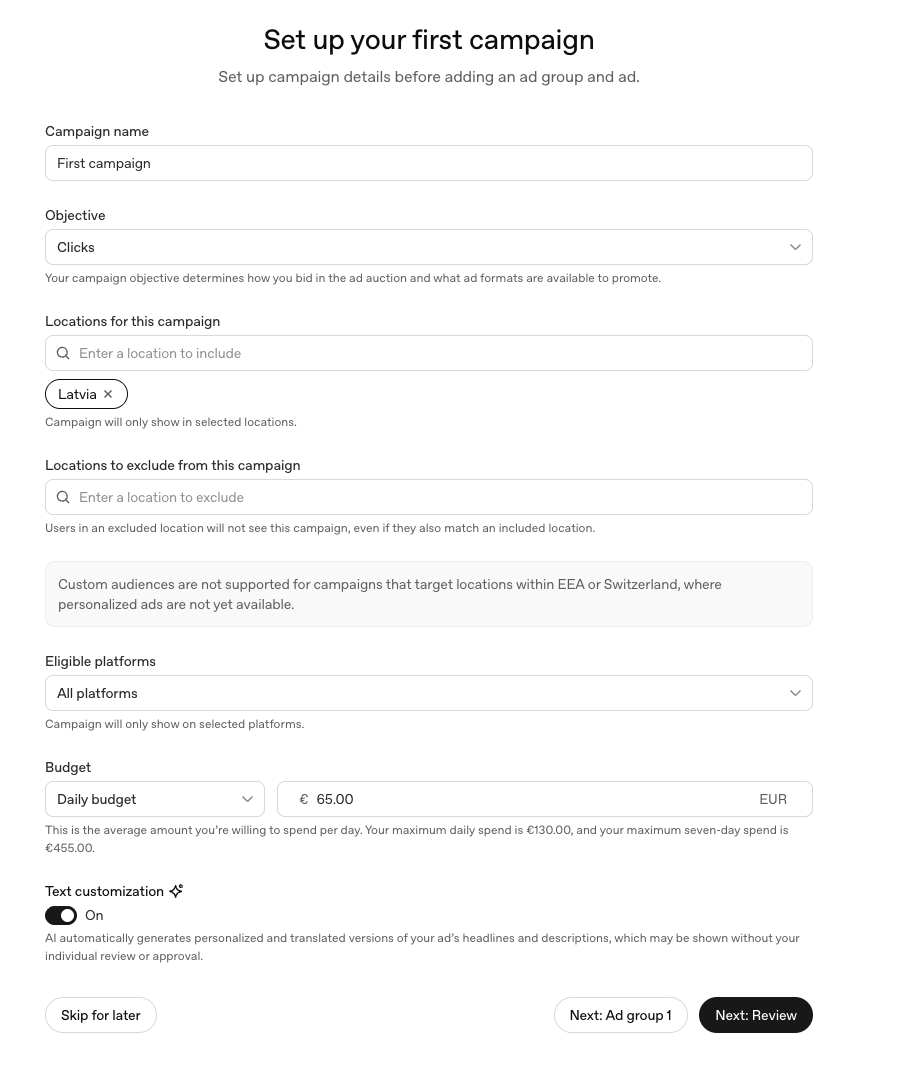
Less than a Google Ads buyer expects. Locations can be included and excluded, and the screen states its own limit plainly: “Custom audiences are not supported for campaigns that target locations within EEA or Switzerland, where personalized ads are not yet available.” In Latvia today you cannot bring an audience, because the personalised layer does not exist here yet.
There are also no keywords, and no language targeting field on either the campaign or the ad group screen. The only inputs are location, platform (Android app, Android web, desktop web, iOS app and iOS web, all selected by default; in early September it was three options, with web as one) and a free-text box called Context hints, whose helper reads: “Describe the conversations, topics, or keywords where your products or services may be relevant; these hints guide matching but aren’t exact-match targeting rules.” Hints, not rules. You describe the conversations you would like to be in, and the matching decides whether you are.
That is worth sitting with before you move a budget across. A keyword plan does not transfer, because there is nothing to transfer it into.
One toggle to find before you fund anything. Text customization is On by default, and its helper text reads: “AI automatically generates personalized and translated versions of your ad’s headlines and descriptions, which may be shown without your individual review or approval.” For a Latvian business that means the headline you wrote can be shown in a machine translation you never saw. Switch it off before the first euro goes in, or leave it on knowing exactly what you have agreed to. We switched ours off. OpenAI’s 16 September update calls text customization something advertisers opt into; on the new-campaign screen that same day it was still On until switched off.
For what it is worth on the privacy side, Digiday reads OpenAI’s EU privacy policy as asking users to opt in to personalised ads rather than relying on legitimate interest. Users who opt in can have their ads history and interests used; users who do not still see ads, chosen from the live conversation and a rough location, with chat history and memory left out. OpenAI declined to comment to Digiday and we could not open the policy ourselves, so that is one publication’s reading. The screen above is the part we can vouch for.
What the ad actually is
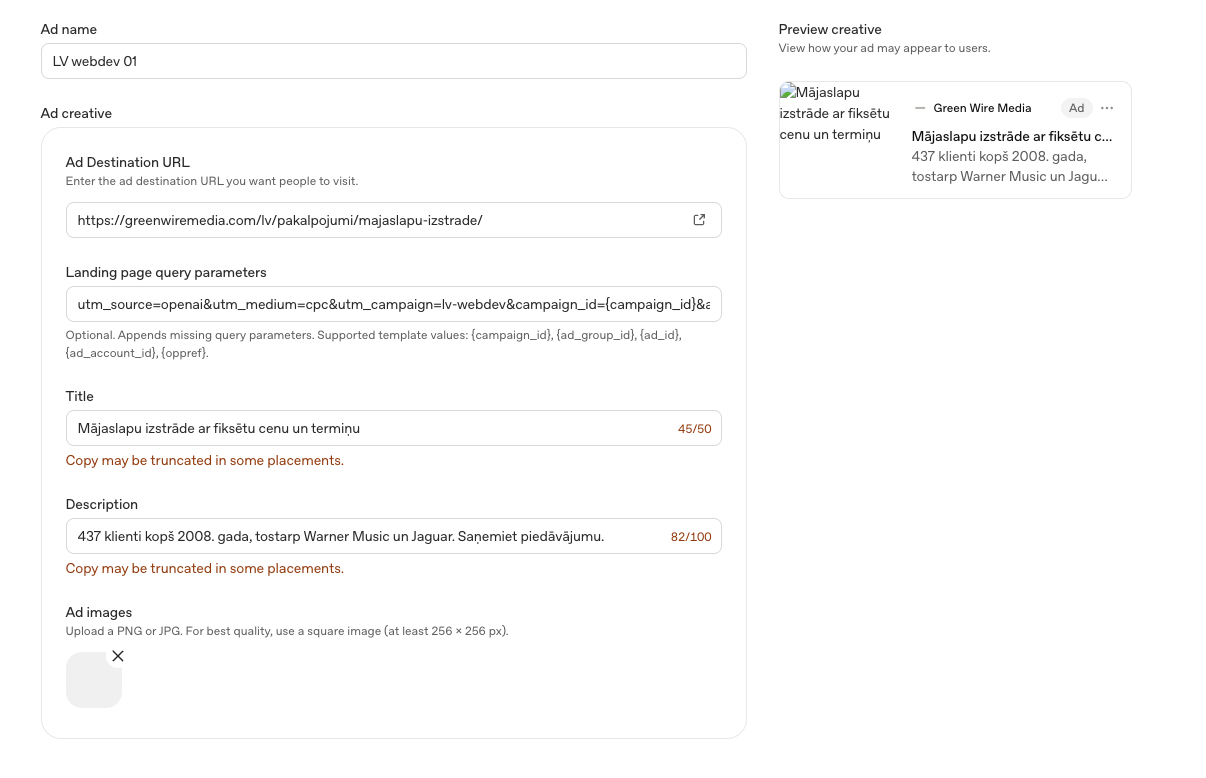
A card. A square image on the left, the advertiser name with an “Ad” badge, then a title of at most 50 characters and a description of at most 100. Images are PNG or JPG, square, at least 256 by 256 pixels.
The character limits are not the useful numbers. At 45 and 82 characters the screen already warned that “Copy may be truncated in some placements”, and in the preview the 45-character title was cut after roughly 30 characters and the description after roughly 55. So write the title so the first 30 characters carry the offer, and the description so the first 55 do. The screen will not tell you that.
Latvian copy with diacritics was accepted exactly as typed. Ours read “Mājaslapu izstrāde ar fiksētu cenu un termiņu”. Read that next to the toggle above: the copy goes in as Latvian, and unless Text customization is off, it may come out as something else.
What a Latvian business can do alone this month
Most of this needs no agency, and it is better to say so.
Open the advertiser account and spend nothing. Self-serve is open to advertisers in approved categories whose ads clear the policy checks, and a Latvian company gets in. Billing is a card charged by OpenAI OpCo, LLC, with a temporary authorisation hold the screen says is typically released within seven days, and nothing serves until billing is set up. The daily budget is in euros with a floor of 15.00 EUR, and the platform caps real spend at twice the daily figure in a day and seven times it over seven days.
Expect the product to feel like the beta it is labelled as. In one evening on a fresh account it asked repeatedly for a data source that was already configured, answered a campaign submission with “Uh oh. Something went wrong. Please try again later.”, and kept showing setup notices for steps we had finished. Whether that is a market opened last week or the normal state of the platform, budget an hour for it.
Expect the verification to be shaped for somebody else.
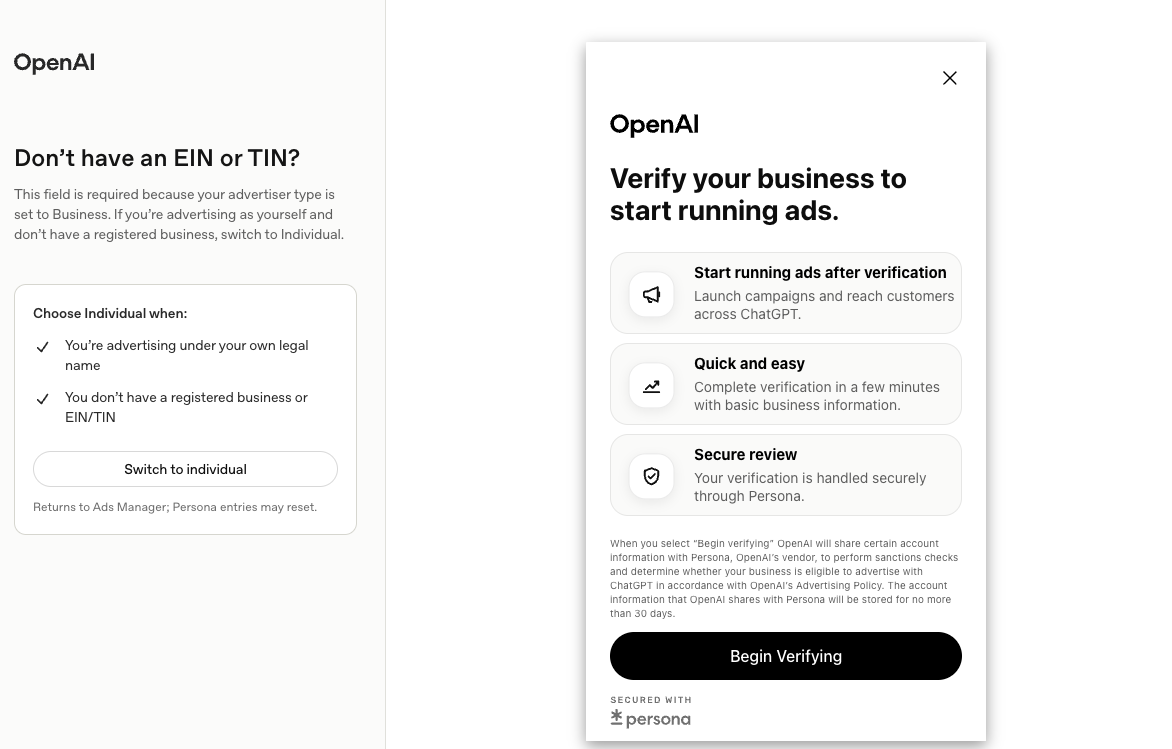
Verification runs through Persona, OpenAI’s vendor. The disclosure says OpenAI shares account information with Persona “to perform sanctions checks and determine whether your business is eligible to advertise with ChatGPT”, and that it “will be stored for no more than 30 days”. The Business advertiser type then asks for an EIN or TIN, both United States tax identifiers, which a Latvian company does not have. The form’s only offered alternative is to “switch to Individual”.
Two screens disagree about whether any of this blocks you. The banner says “Your ads can start serving while this is incomplete”, and the verification modal says “Start running ads after verification”.
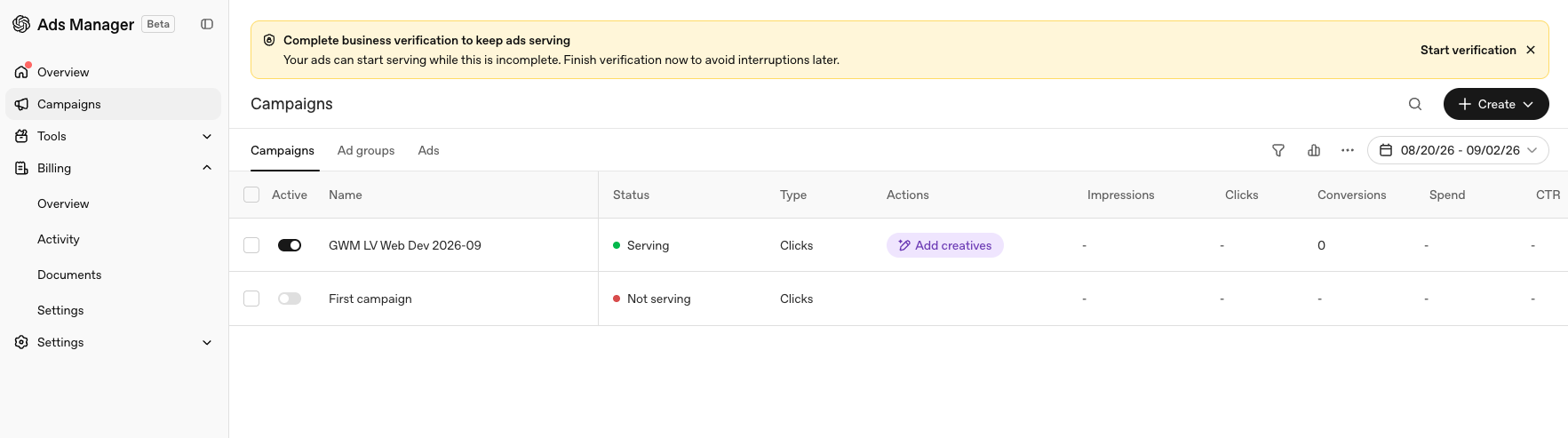
The campaign list settled it within the hour. Our test campaign went to Serving the same evening, with verification still in review and the banner still up. The banner is right: ads run first and verification catches up. The interruption it warns about is the risk you carry in the meantime.
Check whether ChatGPT can read you at all. Two terminal commands, or one look at your CDN panel. The method is in the crawler article above and takes five minutes. A business blocked at the server will not be cited, and an ad does not fix that.
Claim the place record. Foursquare, not Yelp, for a business in Latvia, for reasons the earlier piece sets out. Twenty minutes.
Write down ten questions and ask them. The questions a customer would ask ChatGPT to find a business like yours, with the city in them. Ask them in a Free account and a Plus account, on three separate days, and record who is named, who is cited and which ads appear. That last column is the cheapest competitive intelligence available this month: which competitors are buying, and on which questions.
Then decide about the ad from the Free-account column. A competitor’s ad and no citation for anyone means the ad is worth a small test. A clean answer citing two sources, neither of them you, means the money is better spent on becoming the third source.
What genuinely needs a developer or an agency
Three things.
When the two crawler checks disagree and the CDN panel does not explain why. That is a firewall rule, a rate limiter or a security plugin matching on user agent, and finding it means reading logs. An hour of a developer’s time, not a project.
When the pages you have cannot be quoted. A single-page site with a contact form gives an assistant nothing to extract, and the fix is pages that answer specific questions in the language your customers use, with the address, the coverage area and the prices in text. That is what AI search visibility is as a service: a prompt set from real buyer questions, a baseline across the engines, the rewrites, and a re-probe on a schedule. The ten-questions method above is the same thing in miniature, so run it yourself before hiring anyone.
When you want the ad run properly rather than as a test. Campaign structure, conversion tracking and a rule for when to stop. That is ordinary paid-media work, except the tracking is a developer job before it is a marketing one. OpenAI’s measurement pixel is a browser script that reads a click ID called oppref from the landing page URL into a first-party cookie, sends events such as lead_created and order_created, and pairs with a server-side Conversions API. It has a consent switch that must be set before the script initialises, and with consent false it sends nothing. That puts the pixel behind your cookie consent, where it belongs, and most Latvian sites do not wire consent correctly for the tags they already have. Since mid-September Ads Manager scores each pixel and Conversions API source from 1 to 10 under Tools > Conversions, which is a quick way to see whether the setup is doing its job. It matters more now that the recommended campaign type bills per impression and optimises for a conversion event: with no event arriving, there is nothing to optimise for.
One agency already running client campaigns told Digiday the platform is “very much unproven”. Do not buy a twelve-month ChatGPT ads retainer in September 2026 from anyone.
What we still do not know
Whether the card is the only format. It is the only placement we have seen, and where it sits in a conversation is not shown anywhere in the tool. OpenAI is testing a second experience in the US, Sponsored Agents, where a click opens a conversation with the advertiser’s own agent; nothing says when or whether it comes to Europe. The objective helper says the objective “determines how you bid in the ad auction and what ad formats are available to promote”, so formats vary by whether you pick Reach, Clicks or Conversions. Campaign types are Standard and Product feed, and bid strategy offers one option, “Maximize results”, with no manual bid field.
How long verification takes, and what it costs you to fail. Our campaign served the same evening with no visible ad review, so if one exists it took minutes. Persona verification is the slow half and is still in review. What happens to a serving campaign if it fails, we cannot say yet.
Whether Business and Edu plans are ad-free in Europe. US pilot reports named them; European reports name only Plus, Pro and Enterprise.
The regulatory position. Euronews reported the European Commission is weighing whether ChatGPT’s search function should be designated a very large online search engine under the Digital Services Act, which would bring a public ad repository and audits. Its spokesperson called that “definitely possible”. Chatbot ads have not been tested by regulators or courts.
How much of Latvia is on Free and Go. Nobody publishes it. Assume most people, which returns you to where this started: the paying minority cannot be reached by an ad, and can be reached by a citation.
Where to start
Open the account this week and read every screen before funding anything. Then run the ten questions in a Free account and a Plus account and keep the answers. An afternoon between them, and they replace every article about this launch, this one included.
If you would rather have the measurement built and run properly, that is what AI search visibility is, and we will tell you plainly whether an ad is worth testing on top of it. For an agency whose client has just asked about ChatGPT ads, the answer is the table above: two doors, and the one they can buy is not the one their best customers walk through.