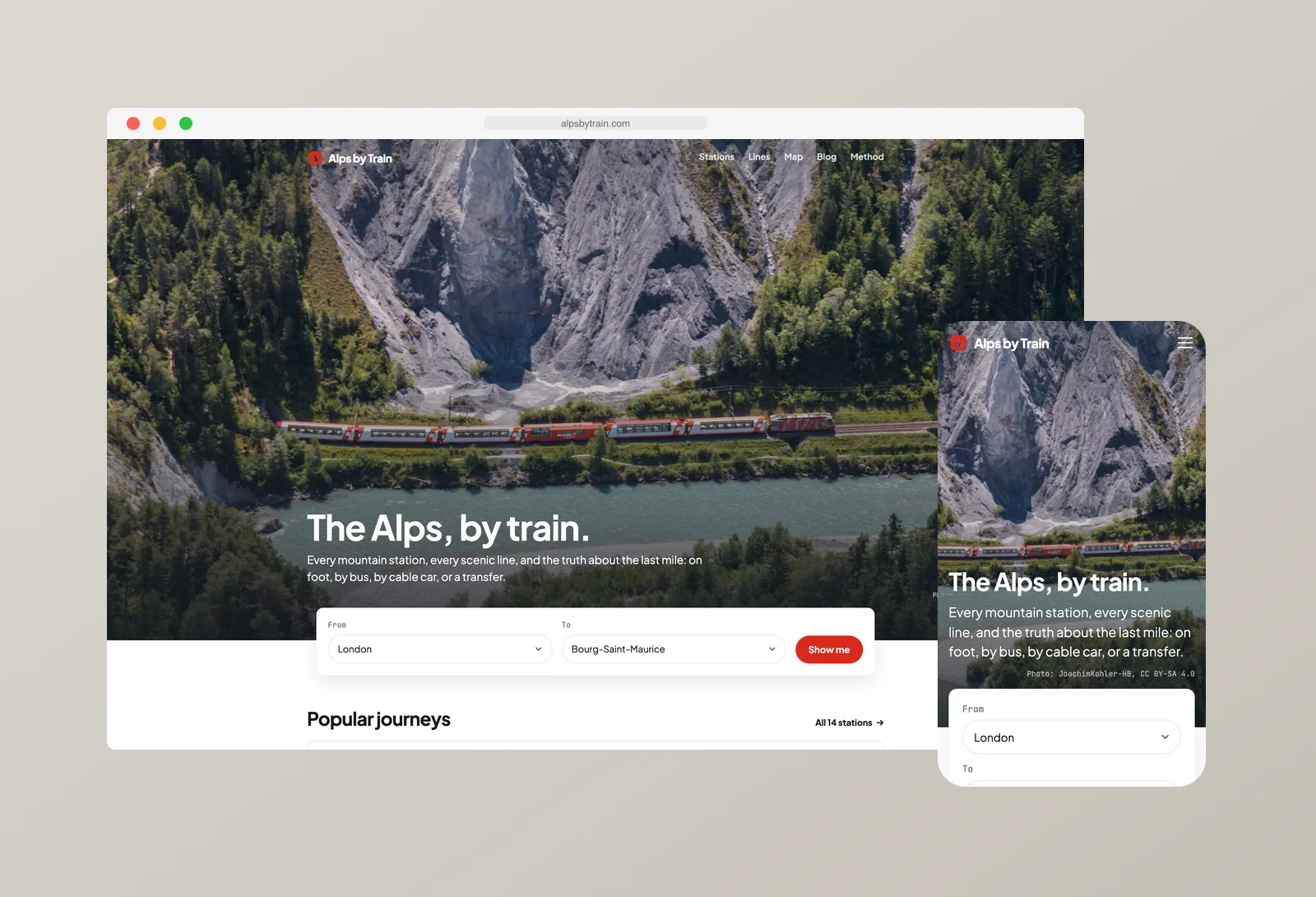
Alps by Train is a rail guide to the Alps built around the question every ski traveller asks before booking a flight: can the train actually get me there? It covers the mountain gateway stations in France, Switzerland, Austria and Slovenia, the scenic lines people travel for, and the part most rail guides skip, the last mile from the platform to the resort.
A verdict, not a timetable
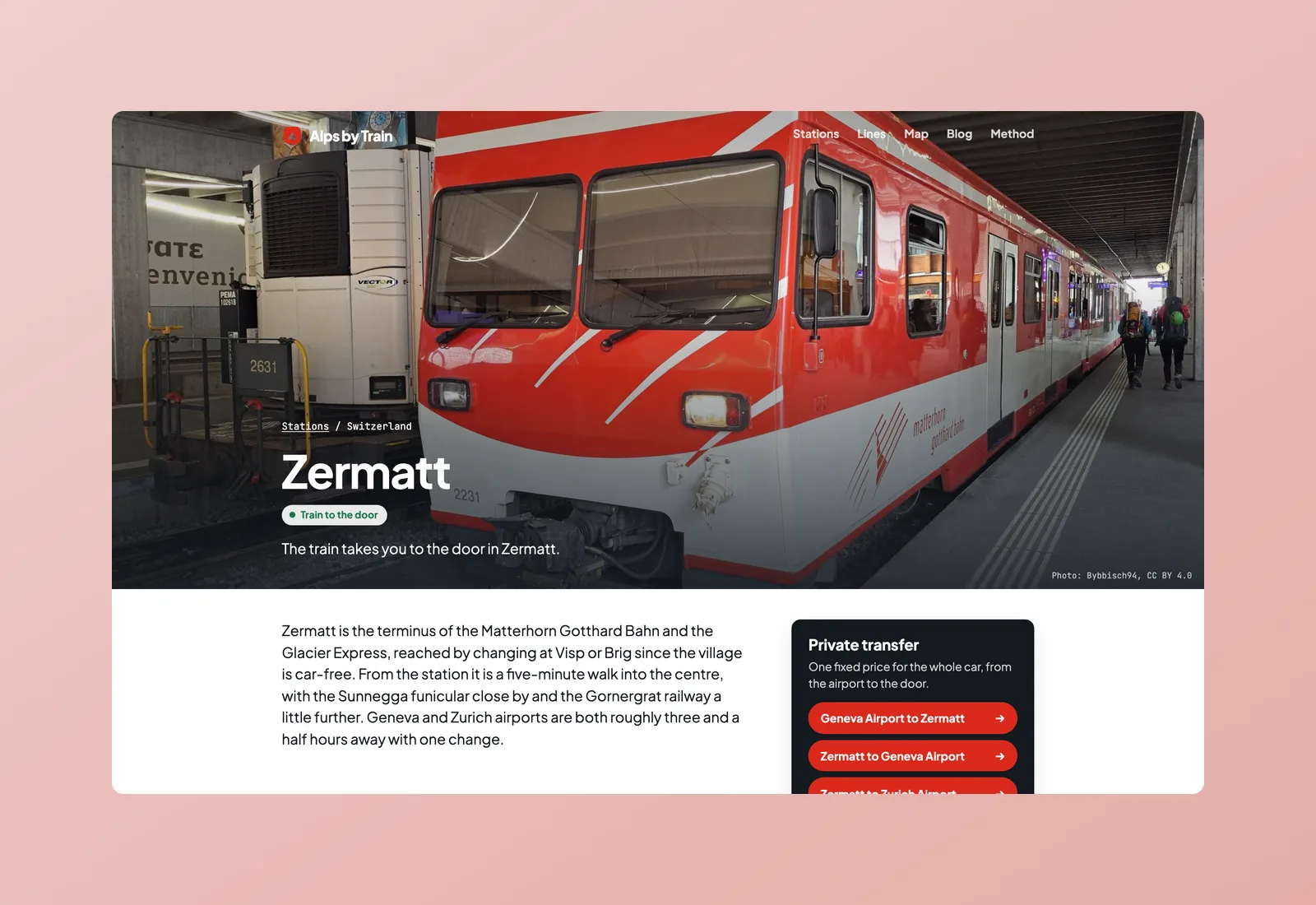
A visitor picks where they start, London, Munich, Amsterdam, Brussels or one of the Alpine airports, and where they are going. Every journey ends in one of three plain answers: the train gets you to the door, a bus or a lift covers the last mile, or a transfer is the better choice. Geneva Airport to Zermatt is about three hours forty with one change at Visp, and the page says so in a line before it says anything else.
Journey times and connections are read from the operators’ own timetables, with the date they were checked on every station page. The site never prints a train fare it cannot stand behind; it sends the reader to the operator’s booking page instead.
A network drawn by hand
The home page carries a schematic of the Alpine rail network in the style of a metro map: straight lines, real connections, from London St Pancras down to Bourg-Saint-Maurice, Zermatt and Lesce-Bled. Hover a station and every line through it lifts. It is a diagram rather than a map, so it loads as plain SVG with no map library and reads just as well on a phone.
Lines worth the ride
Scenic railways are searched far more than any single ski journey, and not only in winter. The Bernina Express, the Glacier Express, the Gotthard Panorama Express, the Mont Blanc Express, the Arlbergbahn and the Brennerbahn each have a page of their own, alongside a blog that covers the dated questions: the Eurostar Snow Train against the Travelski Night Express, or train against private transfer for a group carrying ski bags.
Fast, static and easy to quote
The site is Astro, statically rendered and served from Cloudflare, with light and dark themes and every page shipped as HTML a search crawler or an AI assistant can read without running JavaScript. Each station page opens with a short, sourced answer, which is exactly the kind of sentence an assistant lifts when someone asks how to reach a resort by rail.
Stack: Astro, Cloudflare Pages, GitHub Actions, open European timetable data.